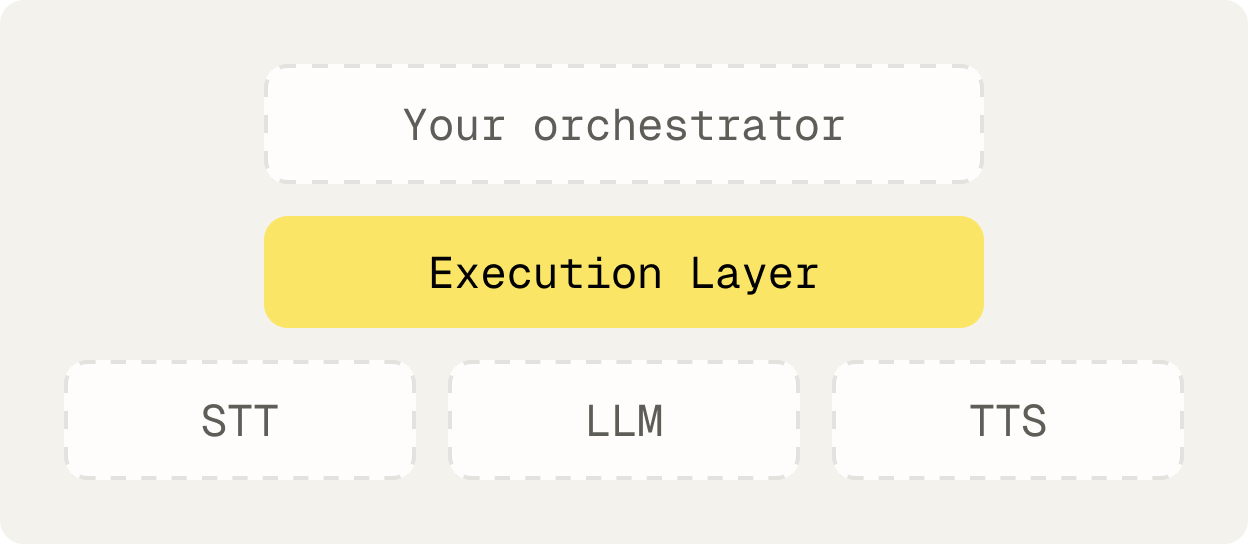
Two boundaries define it. Above it: your orchestrator. It owns the conversation, turn-taking, and session state, and it doesn’t call providers directly. It calls the Execution Layer. Below it: the models, both the ones SLNG runs in-region and the ones proxied to external providers. Diagram: the Execution Layer sits between your orchestrator above and the STT, LLM, and TTS models below. The layer occupies the space in between, and improves the 3 model steps. Your orchestrator asks for a transcript, asks for a response, asks for audio. What runs between the asking and the answering is the Execution Layer, and it can change entirely without your orchestrator noticing. It runs in-region across SLNG regions, next to the models it routes to. With an SLNG-hosted model, the request stays in the region you picked from the layer to the model. That removes a network hop from each turn and keeps request data in that region.